
The ChaiOT
2021-09-25
Imagine, if you will, you are the son of someone who enjoys collecting Hanukkah menorahs (the candle holders used by Jewish people during Hanukkah). You want to get your mom something unique for Hanukkah but you don't know what to get her. So you start thinking about what she would like. Another menorah for her collection? Maybe, but you want it to be something unique, something she can look at and realize that it's one of a kind. And then it hits you! You're a nerd... a tinkerer! You can make something she's never seen before! This is how the ChaIOT was born! The world's first (probably) internet connected smart menorah!
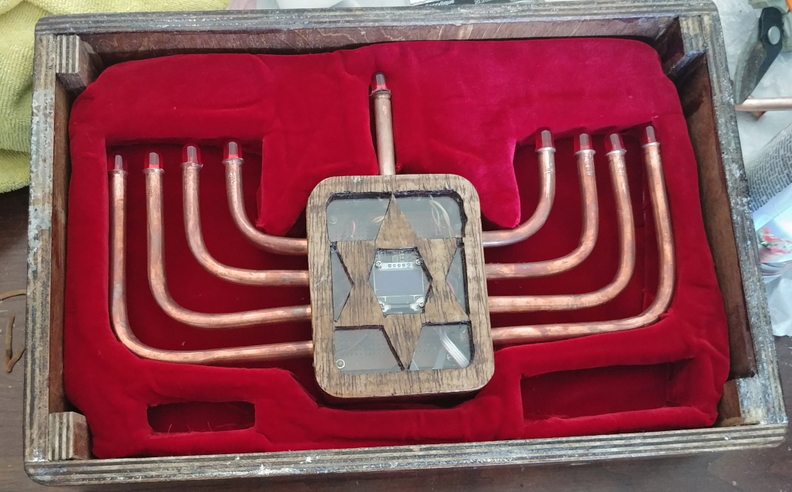
The name comes from the fusion of the Hebrew word 'chai' (not like the tea!), which means "life" and is considered good luck, and the modern acronym IOT, which is short for the Internet Of Things. It is a WiFi-enabled device that is able to connect to the internet to keep it's date and time accurate so that it can light each candle at the proper date and time automatically. The correct dates and times of each candle lighting are preloaded onto the device through the year 2050! Initially the device was going to download the dates and times as needed, but I had some trouble doing that reliably and so I went with a preloaded data model instead. Additionally, the device uses it's WiFi connection to download the latest weather data for the zip code where we live so it can be displayed on the .96 inch OLED screen incorporated into the design. At it's heart, the ChaIOT is powered by an ESP8266 based NodeMCU board, a complete microprocessor development board with all of the necessary components and I/O needed. The OLED screen is connected to the board via the I2C interface, and the 9 lights of the menorah are 10mm red LEDs controlled by the NodeMCU's GPIO pins. It was programmed with ArduinoIDE. The ChaIOT is powered by a micro-USB port on the rear. A standard phone charger is enough to power it, as the device doesn't require much current to work.
The body of the ChaIOT is made from a mix of 1/4" and 1/2" plywood cut, glued, and hand shaped with a bench sander/grinder and hand sanding. The Star of David face panel was hand cut with a jewelers saw and small hand files. The menorah arms are 1/4 inch copper refrigeration tubing, shaped with a hand bender and flared at the end. The arms were also hand polished with high grit sand paper and rubbed with polyurethane to prevent tarnishing. The storage box is made from stained 1/2" plywood glued and tacked together and coated with several coats of spar urethane, which was then hand wet sanded and buffed to a high polish. The hinge and latch hardware are brass and the view window is 1/4" plexiglass. The interior of the storage box is hand cut upholstery foam covered in red satin.
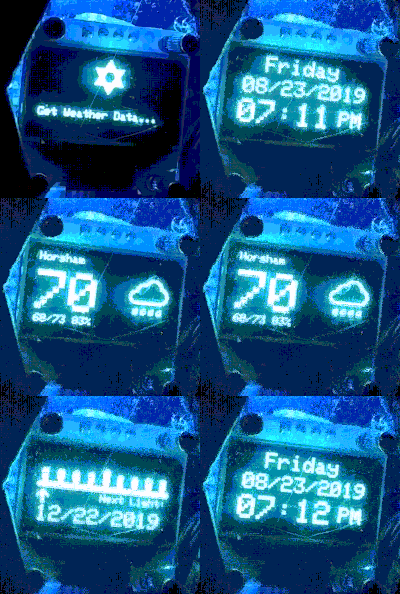
During startup the OLED screen shows a spinning Star Of David icon and status messages below it. Once the system is active the screen cycles through 3 displays, one every 10 seconds. The first display is the date and time display. The second display is the local weather display, including location, temperature, high/low temperatures, humidity percentage, and weather icon. The third display is a status display that shows the current "candle" status, along with which candle is next and when it will be lit (date and time).